Traditional Stucco vs. Synthetic: What's the Real Difference?
Alright, let's talk stucco. If you're looking at putting new stucco on your house here in Concord, or maybe fixing up what you've got, you're probably going to hear about two main types: traditional (sometimes called 'hard coat') and synthetic (also known as EIFS – Exterior Insulation and Finish System). People get these mixed up all the time, or they hear some old wives' tales about one being terrible. I've been doing this for a long time, and I can tell you, both have their place, but one usually makes more sense for us here.
You want to know the real scoop, not just some sales pitch. So, let's lay it all out – what they are, how they stack up, and what I usually recommend for homes around places like the Dana Estates or Clayton Valley areas.
Traditional Stucco: The Old Reliable
Traditional stucco is what most folks think of when they hear the word 'stucco.' It's been around for centuries, and for good reason. It's basically a mix of cement, sand, lime, and water, applied in multiple coats over a wire lath. You get a scratch coat, a brown coat, and then a finish coat. This stuff is hard, dense, and breathable.
- Cost: Generally, traditional stucco is less expensive to install upfront than synthetic. You're looking at materials that are pretty standard and a process that's well-understood by most skilled stucco crews.
- Durability: This is where traditional stucco really shines. It's incredibly hard and resistant to impact. If a kid hits it with a baseball, you're more likely to see a dent in the ball than a hole in your wall. It stands up great to our hot Concord summers and those occasional heavy winter rains.
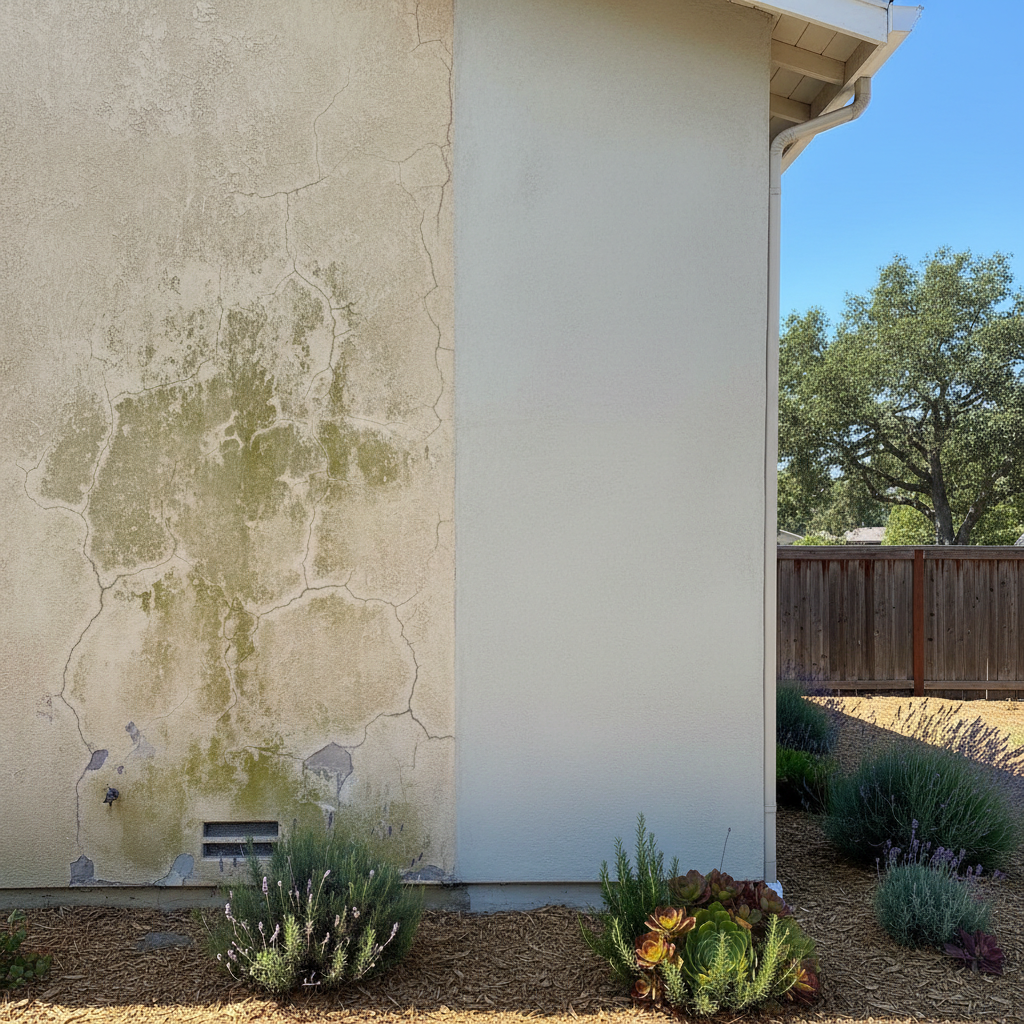
- Maintenance: Pretty low maintenance. You might need to clean it periodically, and if you get a crack (which can happen with any house settling), it's usually straightforward to patch. It's naturally resistant to mold and mildew because it breathes.
- Appearance: You get that classic, solid, masonry look. It can be textured in many ways – smooth, sand finish, dash, Santa Barbara. It's got a timeless appeal.
- Water Management: This is key. Traditional stucco is designed to absorb a bit of moisture and then dry out. It's not a waterproof barrier; it's a water-resistant, breathable system. Any water that gets behind it (say, from a leaky window) can usually drain and dry out.
Synthetic Stucco (EIFS): The Modern Option
Now, synthetic stucco, or EIFS, is a different beast entirely. It's a multi-layered system that starts with a layer of foam insulation board, which is then covered with a fiberglass mesh, a base coat, and finally a finish coat that looks like traditional stucco. It's essentially an exterior insulation system with a stucco-like finish.
- Cost: Typically, EIFS is more expensive to install than traditional stucco. The materials are more specialized, and the installation process is more intricate, requiring specific expertise to get it right.
- Durability: It's not as impact-resistant as traditional stucco. That foam board underneath can dent if hit hard enough. While the finish coat is durable, the underlying structure is softer.
- Maintenance: Requires careful maintenance. Because it's designed to be a barrier, if water gets trapped behind it (from a bad seal around a window or door, for example), it can cause serious problems like rot and mold that are hard to detect until it's too late. Repairs can be more complex and costly.
- Appearance: It can mimic traditional stucco finishes very well. The advantage here is that because of the foam, you can achieve much more intricate architectural details and curves that would be difficult or impossible with traditional stucco.
- Water Management: This is the big one. EIFS is designed to be a complete barrier system. If installed perfectly and maintained meticulously, it works. But if there's even a tiny breach – a crack, a poorly sealed window, a flashing issue – water can get in and won't have anywhere to go. It gets trapped against the sheathing, leading to rot. This is why EIFS got a bad rap in some areas years ago, though modern systems have improved.
My Recommendation for Concord Homeowners
Look, both systems have their pros and cons. But for most homeowners here in Concord, especially with our climate and the way our homes are built, I almost always recommend traditional stucco.
Why? It comes down to a few things:
- Forgiveness: Traditional stucco is a lot more forgiving when it comes to moisture. It breathes. If a little water gets behind it, it can dry out. With EIFS, if water gets in, it stays in, and that's a recipe for disaster in the long run.
- Durability: You just can't beat the impact resistance of traditional stucco. It's a tough, solid wall.
- Cost-Effectiveness: It's usually less expensive to install and generally cheaper to maintain or repair over its lifespan.
- Proven Track Record: It's been used successfully for centuries. We know it works, and we know how to fix it if something goes wrong.
Now, if you've got a super modern, custom home design with wild curves and you're absolutely committed to a perfect, sealed envelope, EIFS *could* be an option, but you'd need an incredibly meticulous installer and a rigorous maintenance plan. But for the average home, especially those older ranch-style houses you see all over Concord, traditional stucco is the smart, reliable choice.
We at Concord Stucco & Plastering specialize in traditional stucco because we believe it offers the best long-term value and peace of mind for our neighbors. You want a wall that's going to last, look good, and not give you headaches down the road. That's what traditional stucco delivers.